
Yes. A properly built screen room can keep most mosquitoes out, but it is not an invisible force field around the patio. The mesh needs to be appropriate for insects, stretched and secured without tears, and continuous at the wall panels, roofline, corners, floor, and door. The door also has to close fully, with weatherstripping or a sweep that does not leave an easy opening at the threshold. Finer mesh can improve protection from very small insects, though it may change airflow, visibility, and light. Good drainage and weekly removal of standing water around the room still matter because screens reduce entry; they do not stop mosquitoes from breeding elsewhere in the yard.
How Does a Screen Room Block Mosquitoes?
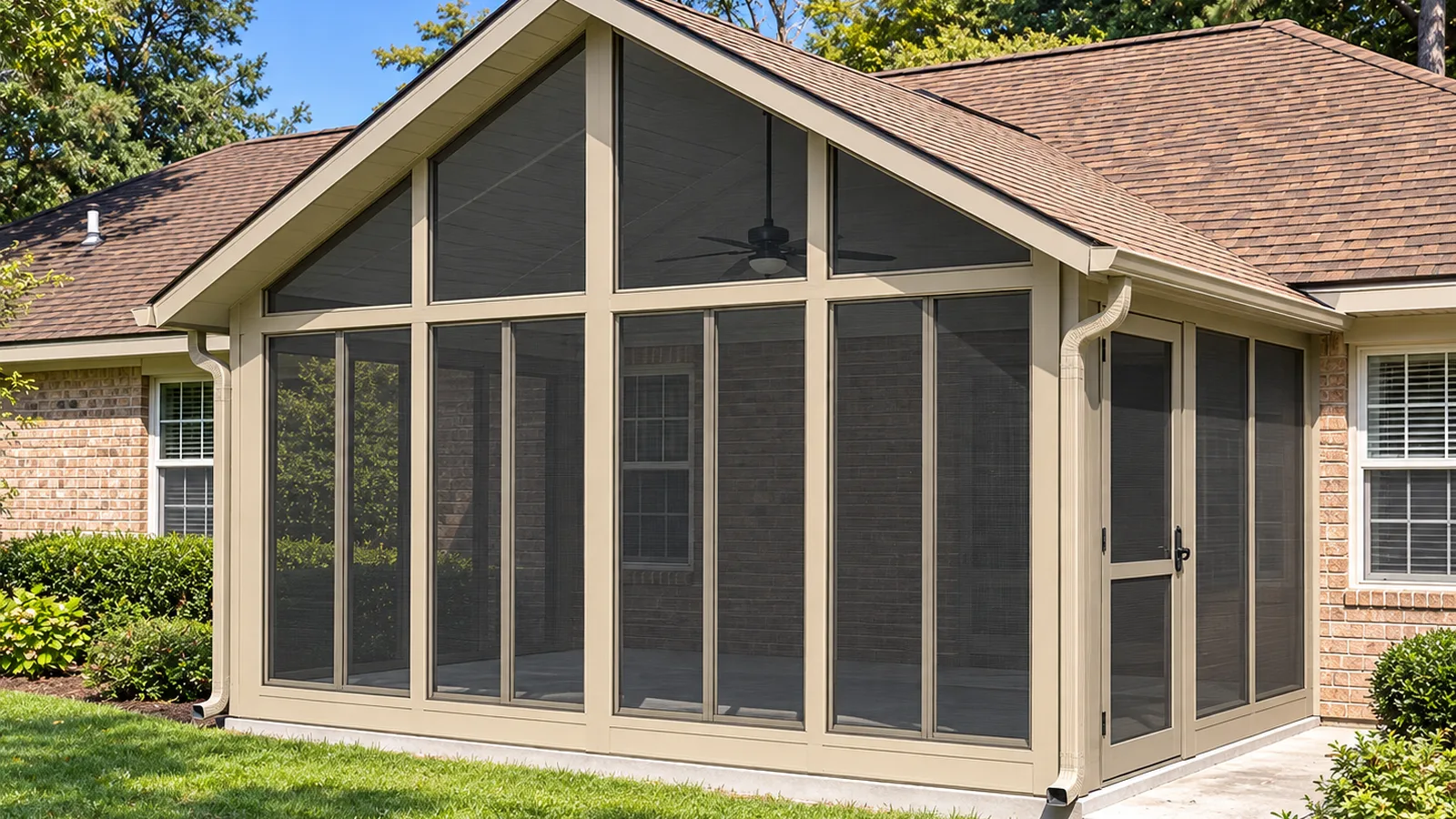
A screen room works as a physical barrier. Air and daylight pass through thousands of small openings while the mesh blocks insects that are too large to fit through them. That simple idea works only when the barrier continues around the entire occupied space. A large field of perfect mesh cannot compensate for a gap under the door, a torn corner, or an opening where a panel meets the house.
The most reliable enclosure treats the roof, posts, framed screen panels, base rail, door, threshold, and house connection as one system. Mesh should remain taut and securely retained at its edges. Panel frames should meet cleanly, and penetrations for wiring or other accessories should not leave unsealed paths. At the floor, the enclosure needs a detail that closes the gap without trapping water against framing or creating a difficult-to-clean channel.
Screens reduce mosquito entry while the room is closed, but normal use still matters. Mosquitoes can follow people through a door that stays open, enter through a damaged panel, or remain inside after being carried in with plants or belongings. A quick check of the door and screens before peak mosquito season is more useful than assuming the enclosure will remain bug-tight without care.
- Look for tears, pulled corners, loose spline, bowed frames, and openings at panel joints.
- Check the full door perimeter, including the latch side, hinges, top edge, and bottom sweep.
- Inspect where the enclosure meets brick, siding, trim, the roof, and the floor.
- Keep accessory wiring and mounting holes sealed with details suited to the enclosure system.
- Repair small defects before wind, repeated door use, or cleaning makes them larger.
What Screen Mesh Works Best for Mosquitoes and Tiny Insects?
Standard insect screen is intended to keep out common flies and mosquitoes while preserving generous airflow and visibility. For many Charlotte-area patios, that balance is the practical starting point. The exact material, strand thickness, opening size, color, and attachment method still vary by screen product, so compare current samples rather than selecting from a generic label alone.
Mosquitoes are not the smallest insects homeowners notice. Gnats, midges, and insects commonly called no-see-ums can require a tighter weave. TEMO currently lists multiple screen options for its enclosures, including fiberglass memory mesh and 20-by-20 no-see-um mesh. Phifer likewise explains that its finer no-see-um products use a tighter weave to block most very small insects. Those manufacturer descriptions are useful for comparing options, but they are not a promise that no insect can ever enter a finished room.
Tighter mesh changes more than bug protection. More strands can reduce open area, which may affect the breeze, view, daylight, and how quickly pollen or dust becomes noticeable. Dark mesh often provides a clearer outward view in daylight than bright mesh, but the actual effect depends on the product and surroundings. Review full-size samples from both inside and outside, then choose the screen that fits the insects, exposure, cleaning routine, and view that matter at your home.
- Start with the insects you actually want to reduce: mosquitoes, tiny gnats, or both.
- Compare airflow and visibility through real samples rather than relying only on mesh counts.
- Ask how the selected mesh is retained, repaired, and replaced in the proposed panel system.
- Consider pet-resistant material only where scratching or impact is a genuine concern.
- Keep expectations realistic: finer mesh improves the barrier but does not replace door discipline or yard mosquito control.
Why Do the Door and Threshold Matter So Much?
The door is the largest opening used every day, so its fit often determines how bug-resistant the room feels. A screen door should sit square in its frame, latch without being forced, and return to the closed position reliably if the chosen hardware includes a closer. A dragging door, loose latch, or warped frame can leave a wedge-shaped gap even when the handle appears shut.
The bottom edge deserves a close look. The threshold has to work with the patio or deck surface, manage water, and remain practical to walk across. A sweep that hangs too high leaves a route for insects; one that drags heavily may prevent the door from closing. Irregular pavers, sloped slabs, deck-board gaps, and abrupt floor transitions can complicate this detail if they are not measured before the enclosure is designed.
Door location affects performance too. Place it where people can move between the house, yard, grill, pool, or garden without holding it open for long periods. Avoid crowding the swing with furniture or steps. If the room has more than one door, each opening adds convenience but also creates another threshold, latch, and perimeter that must stay aligned and maintained.
Will a Screen Room Solve Mosquitoes in the Whole Backyard?
No. The enclosure protects the space inside its barrier; it does not eliminate mosquitoes from the property. The Centers for Disease Control and Prevention recommends installing or repairing door and window screens, keeping doors closed, and removing standing water where mosquitoes lay eggs. Those same principles apply around a screened outdoor room.
Inspect the immediate area after rain. Gutters should drain instead of holding debris and water. Downspouts should discharge away from the room without creating a persistent puddle at the slab, deck posts, steps, or planting bed. Empty and clean items such as plant saucers, buckets, toys, birdbaths, tarps, furniture covers, and other containers on a regular schedule. A screened room beside a water-holding planter still leaves a mosquito source near the door.
Water management is also part of enclosure durability. The roof should direct runoff to a planned destination, and the floor should not funnel water beneath door sweeps or wall framing. Correcting low spots, clogged drainage, and splashback can improve the room while reducing nearby standing-water opportunities. Address the drainage path during design rather than treating gutters and grading as accessories added after installation.
- Walk the room perimeter after a typical rain and note every place water remains.
- Keep roof gutters and downspout outlets clear and directed to an appropriate discharge area.
- Empty or cover small containers that can collect water near the patio.
- Repair torn screens and avoid leaving the screen door propped open.
- Use public-health guidance for mosquito control rather than relying on the enclosure as the only measure.
How Do You Keep the Room Comfortable Without Weakening the Barrier?
Plan comfort around the screen rather than cutting unplanned openings later. Roof shade, room orientation, panel size, door placement, ceiling height, and mesh openness all influence airflow and heat. A covered screen room may feel much cooler than an uncovered patio in direct sun, but it remains an outdoor space unless it is designed and approved as a different type of enclosure.
Fans, lighting, receptacles, and other accessories should be coordinated before framing is finalized. Mounting points, wiring routes, clearances, weather exposure, and service access need to suit the exact roof and enclosure. Do not puncture screen panels or improvised trim simply to route a cord. If powered features are part of the plan, include them in the project scope so penetrations can be detailed without leaving insect gaps.
Cleaning should protect both visibility and attachment. Start with the screen manufacturer's care instructions. Gentle rinsing and a soft brush or cloth are generally easier on mesh and spline than aggressive pressure washing, but the approved method depends on the installed product. Inspect seams and door alignment while cleaning, and replace damaged sections with compatible material instead of layering a patch that interferes with the frame or view.
What Should Charlotte Homeowners Decide Before Ordering a Screen Room?
Begin with the existing patio, deck, or porch. Record its dimensions, slope, drainage, condition, door locations, roofline, utilities, and the paths people use between the house and yard. Decide whether the enclosure will be a new room with its own roof or a retrofit beneath a suitable existing cover. The screen system cannot correct an inadequate roof, unstable base, or unresolved water problem by itself.
Next, rank the room's priorities. A homeowner focused on common mosquitoes and maximum breeze may choose differently from someone bothered by very small insects, pets, intense afternoon sun, or heavy pollen. Compare mesh samples, panel sizes, door locations, views, cleaning access, shade, and future upgrade goals as one package. Avoid choosing the tightest screen automatically if it makes the room feel darker or less ventilated than expected.
Unique Patio Concepts can help Greater Charlotte homeowners plan the enclosure, roof, door, floor transition, drainage, and screen selection together. Requirements and suitable details vary by property and jurisdiction, especially when the project adds a roof, alters a deck or porch, or includes electrical work. Confirm the current approval path and complete scope for the address before materials are ordered.
- Identify whether common mosquitoes, tiny insects, pets, pollen, sun, or wind-driven rain is the main concern.
- Review mesh samples for protection, airflow, visibility, color, strength, and cleaning needs.
- Measure every door swing, step, threshold, walkway, and furniture zone.
- Resolve roof attachment, gutters, downspouts, floor drainage, and grading before installation.
- Plan compatible lighting, fans, receptacles, and other accessories before framing is closed.
- Confirm address-specific permits, HOA review, and trade requirements for the final project.
Plan a screen room around the insects and comfort issues that matter
Request a Greater Charlotte screen-room consultation from Unique Patio Concepts to compare mesh, doors, roof options, drainage, and site conditions.
Request a free estimateFrequently asked questions
Can mosquitoes get through normal screen mesh?
Standard insect screen is designed to block common mosquitoes when it is intact and installed continuously. Mosquitoes can still enter through tears, loose edges, gaps around frames, an open door, or an ineffective bottom sweep. Very small gnats or no-see-ums may require a finer mesh.
Is no-see-um screen better than standard mosquito screen?
It provides a tighter barrier against many tiny insects, but better depends on your priorities. Finer mesh can change airflow, visibility, daylight, cleaning, and cost. Compare real samples and the installed system rather than choosing by mesh count alone.
Will a screened porch be completely bug-free?
No enclosure can guarantee that every insect stays out. A well-fitted screen room can greatly reduce mosquitoes and other insects, but doors, tears, utility openings, items carried inside, and maintenance all affect the result.
What is the most common place mosquitoes enter a screen room?
Doors and damaged edges are common weak points. Check the bottom sweep, latch and hinge sides, threshold, loose spline, panel corners, roof and wall joints, and any opening made for wiring or accessories.
Does standing water matter if the patio is screened?
Yes. Standing water near the room can support mosquito breeding and increase activity around the door. Keep gutters and drainage working, and regularly empty or cover nearby containers that hold water.
Can a screen room be added to an existing Charlotte patio or deck?
Sometimes. The existing roof or proposed new roof, floor or deck structure, foundations, drainage, thresholds, attachment, and access all need review. A finished patio surface or deck board alone does not prove the site is ready for an enclosure.